
When Social Media Becomes Evidence: How WhatsApp Chats and Posts Are Used in Court
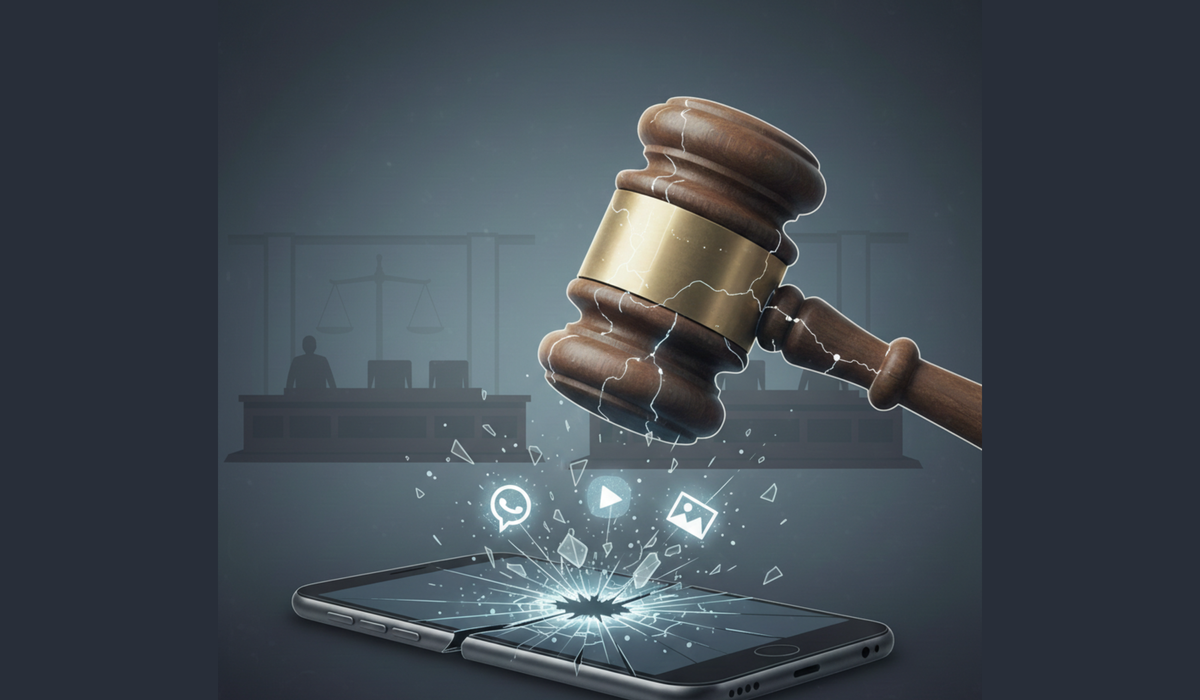
Not too long ago, evidence meant paper records, witnesses, and documents filed in court. Today some of the most decisive evidence in litigation comes from electronic devices.
From WhatsApp conversations in matrimonial cases to social media posts in criminal investigations, courts are increasingly asked to decide a simple but complex question: Can social media content be admitted as legal evidence in court?
In India the answer is yes but subject to specific conditions under the Bharatiya Sakshya Adhiniyam (BSA), 2023.
This article explains how Indian courts treat WhatsApp chats and social media posts as evidence, the legal framework under the BSA, key judicial rulings, and practical challenges.
The Legal Framework for Electronic Evidence
The BSA modernises the law of evidence by treating electronic records as documentary evidence. Section 62 of the BSA provides that the contents of electronic records may be proved in accordance with Section 63.
Section 63(1) of the BSA states that any information from an electronic record, whether printed, stored, or copied from a communication device, shall be treated as a document and admissible in any proceedings if the conditions in that section are met.
These conditions include:
- The record must have been generated and stored by a computer or communication device that was regularly used for that purpose.
- The device must have been operating properly or not in a manner that affects the information’s accuracy.
Section 63(4) of the BSA requires that when an electronic record is tendered, a certificate must be submitted identifying the record, describing how it was produced, and giving appropriate device particulars. This certificate must be signed by a person in charge of the device or relevant activities and is evidence of the matters stated in it.
Effectively WhatsApp chats and social media posts can be admitted if accompanied by such certification as required under Section 63(4).
Landmark Case Laws
Although the BSA is now the governing law, earlier rulings under the Indian Evidence Act remain powerful guides on electronic evidence.
Anvar P.V. v. P.K. Basheer & Ors. (2014)
In this Supreme Court decision, the Court held that electronic records cannot be admitted without compliance with Section 65B of the IEA (the precursor to Section 63 of the BSA). It stressed that the special provision for electronic evidence takes precedence over general documentary rules. This remains persuasive for issues of authenticity and certification.
Arjun Panditrao Khotkar v. Kailash Kushanrao Gorantyal & Ors. (2020)
This Supreme Court ruling clarified that the certification regime under Section 65B of the IEA is required when electronic evidence in the form of copies is produced. If the original device itself is produced and authenticated a certificate may not always be needed. These principles are carried forward in the BSA’s Section 63 framework on admissibility and certification.
How WhatsApp and Social Media Evidence Are Used in Criminal Cases
In criminal proceedings courts often see WhatsApp chats and social media posts used to prove charges such as conspiracy, harassment, cyberstalking, defamation, and fraud.
For admissibility the prosecution typically has to satisfy the following:
Authentication
The court must be satisfied that the communication is genuine and not tampered with. This is usually done through forensic extraction reports, metadata, officer testimony, or expert affidavits.
Attribution
It must be shown that the message was sent or received by a particular person. A phone number or username alone is not sufficient without supporting evidence on ownership, SIM registration, or account access.
Certification under the BSA
If the content is presented as a copy or export from a device, it must be accompanied by a certificate under Section 63(4). Without it courts may reject the material as unreliable.
In practice screenshots without certification are treated with caution due to ease of fabrication. Proper forensic preservation and certified metadata improve admissibility and evidentiary weight.
Civil Litigation: Contracts, Matrimonial and Commercial Disputes
Civil courts are more flexible and regularly admit WhatsApp chats and social media content as evidence in:
- Contractual disputes where messages record negotiations or acceptance.
- Matrimonial and family law matters where messages show conduct, timelines, or admissions.
- Commercial cases and employment disputes where digital communication is central to understanding intent and performance.
Family courts and civil benches often require certification under Section 63(4) when secondary electronic evidence such as exported chats are tendered. However original devices authenticated before the court can sometimes serve as primary evidence without the same procedural burden.
Practical Challenges
Despite judicial acceptance, digital evidence presents challenges:
- Screenshots are easily manipulated and may lack metadata without proper extraction methods.
- Proving the identity of a sender or poster may require circumstantial and technical evidence.
- Platforms like Meta control server logs and access is usually available only through orders.
- Courts balance privacy with probative value, but privacy does not bar admissibility when evidence is relevant and properly authenticated.
Conclusion
Social media content such as WhatsApp chats and posts have become standard evidence in modern litigation.
For lawyers and law students understanding how to preserve, authenticate and certify digital evidence is now essential. The question for modern litigation is no longer whether social media can be evidence but whether it can be proven properly under the BSA’s requirements.
![FSSAI Internship 2026 [Stipend Rs. 10K, New Delhi] – Apply by March 27!](/content/images/size/w600/2026/03/1740116165172.jpeg)

![Senior Professional (Patent Paralegal & Docketing) at Khurana & Khurana [5–10 Yrs Exp, Greater Noida] – Apply Now!](/content/images/size/w600/2026/03/khurana_and_khurana_logo.jpeg)