
Critical Analysis of the 130th Constitutional Amendment bill, 2025
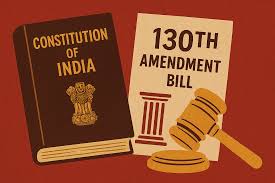
The 130th Constitutional Amendment Bill, 2025, was introduced in the Indian Parliament on August 20, 2025. This bill represents one of the most controversial constitutional proposals in the recent Indian political history.
It seeks to provide for removal of the Prime Minister, a Chief Minister of a state, or any other Minister in the central or state government, if he is arrested and detained in custody on account of serious criminal offences. It also applies these provisions to the Union Territory (UT) of Delhi. Two other Bills have also been introduced to apply these provisions to the UTs of Puducherry, and Jammu and Kashmir. [1]
The major amendments which are proposed in this bill are amending the three critical articles Article 75, Article 164, Article 239AA of the Indian constitution. According to the bill a new clause will be inserted in those Articles which would include the automatic removal of ministers under specific circumstances.
Grounds and Procedure for removal
A Minister will be removed from office if:
(i) he is accused of an offence punishable with imprisonment for a term which may extend to five years or more,
(ii) he has been arrested and detained in custody for 30 consecutive days.
A Minister in the central government will be removed by the President on the advice of the Prime Minister. This advice is to be given by the 31st consecutive day that the Minister is in custody. If the Prime Minister does not advise the President by this time, the Minister will cease to hold office from the day thereafter. The same provisions will also apply at the state level, with the Governor of the state acting on the advice of the Chief Minister. In case of Delhi, the acting authority will be the President on the advice of the Chief Minister.
In the case of the Prime Minister, or a Chief Minister of a state or Delhi, he must resign by the 31st consecutive day of custody. If he does not resign by this time, he will cease to hold office from the day thereafter.
No bar on re-appointments: A Minister who is removed from office under these provisions, may be re-appointed after being released from custody.[2]
Political Context and Rationale
The amendment’s introduction was influenced by several high-profile cases where elected leaders continued in office despite prolong detention. The case of V. Senthil Balaji vs The Deputy Director[3] remained in custody for extended periods on money laundering charges and the Jharkhand Chief minister Hemant Soren’s case where he resigned hours before the arrest but was resumed the office after bail, even in Arvind Kejriwal’s case, the Supreme Court imposed restrictions but left resignation to discretion. These cases demonstrate a clearer constitutional provision.
The Governments justification for this bill rests on several pillars:
- Upholding constitutional morality.
- Enhancing public trust.
- Ensuring good governance.
- Preventing the criminalization of politics.
The bill's Statement of Objects and Reasons argues that ministers facing serious criminal allegations who remain in custody may "thwart or hinder the canons of constitutional morality and principles of good governance" and "diminish the constitutional trust reposed by people". This reflects a broader governmental agenda to strengthen political integrity and respond to public outrage against corruption in politics.
Constitutional and Legal Criticisms
Presumption of innocence
This amendment faces significant criticism for violating the core principle “innocent until proven guilty.” Removal based on detention, and not conviction, is considered a legal framework breach by most critics.
Senior advocate Indira Jaising argues that “weaponizes the Constitution” for the very reason that “criminal law is used for persecution, not prosecution” in this country.[4] As a matter of fact, constitutional experts have pointed out that India’s legislative policy, until recently, sheltered public office holders from disqualification on the grounds of unproven conviction, realizing the threat of political vendetta.
The concern arises from the fact that the presumption of innocence is reversed in this case, especially in light of how opposition leaders have been arrested and held for superlong periods of time, only to be released for lack of evidence.
Scope And Definitional Issues
In India there are more than 2000 offenses which constitute organized crimes or, at the other end, less serious offenses like obstructing public servants which come alongside sentences of five years and more. Because of such definitional flexibility, ministers might face removal from their positions over frivolous allegations for what might be minor charges within the legal framework.
Concerns have been raised with the use of “any law for the time being in force” due to the unduly broad such phrasing poses, thus presenting risks of overreach within numerous domains of criminal law. It remains unclear why the bill’s objects of statement calls to “serious criminal offenses," yet the law itself does not contain such language.
Threat to Federal Structure
The threat arises due to the possibility that the authority to dismiss head of state ministers may be granted to the Governors, who are union appointees, therefore permitting the Union government to meddle indirectly into state matters.
The investigative provisions of the central government can be seen as attempts to undermine elected state governments, and this may result in political disorder and damage the trust that exists between the Union and the states.
The seriousness of the apprehensions regarding this aspect of federalism is accentuated by the fact that numerous states governed by the opposition are currently under investigation by central agencies.
Democratic Accountability vs. Potential misuse
While the amendment aims to enhance democratic accountability, critics argue it could become a tool for political persecution. Opposition leaders have expressed apprehensions about the law being used to settle political scores and dismantle democratically elected state governments. The concern is that central agencies like the CBI and ED could be used to arrest opposition leaders and keep them in custody long enough to trigger disqualification.
Parliamentary Process
Joint Parliamentary Committee Examination
The Bill has been referred to Joint Parliamentary Committee (JPC) for detailed examination. The JPC, which consists of both Houses of Parliament in a 2:1 proportion of Lok Sabha to Rajya Sabha, will review the bill's scope, speak to important people, and give the JPC report in the next parliamentary session.
The in-depth review and the opportunity for change due to the committee process, is beneficial for addressing the concerns that were raised. The fact that the government chose to send the bill to a JPC conveys that the bill is, in fact, controversial and that the government understands the article in question requires a lot of consideration.
How does this affect the aspect of democracy?
This amendment illustrates rooted conflict in Indian democracy: balancing accountability with democratic safeguards. The dispute has turned into a referendum on the destiny of India's federal democracy, where both factions claim true constitutional allegiance.
This, however, has broader ramifications with enhanced scrutiny on the functioning of central agencies and the politics of opposition in India. The amendment could either be seen as a necessary reform for clean governance or as another tool for political centralization.
Conclusion
The 130th Constitutional Amendment is one of the more recent attempts to balance the concerns of the accountability of elected representatives with deeper issues of democracy, constitutional equilibrium, and the rule of law in India. While the attempts to promote constitutional morality and the witch hunt against governed ministers seems noble on the surface, the actions that come with them to enforce those changes are troubling in terms of constitutional principles and India’s federal structure.
The constitutional principles are undermined with the broad removal scope, automatic removal, and executive removal in lieu of judicial removal of consequences. Moreover, a very striking paradox is the extreme aim for the change and the immense potential for its misuse. This is very common in the Indian democratic narrative where there seems to a perennial battle for a cleaner government and the need to respect democratic principles.
This dissection of the Joint Parliamentary Committee presents a chance to resolve some of these issues through changes that could retain the amendment's accountability goals while providing greater safeguards against misuse. that must be contemplated include the tension between deterrent and conviction-based consequences for constitutional office bearers. The reasoning must combine constitutional fundamentals, democratic ideals, and the pragmatics of governance.
Ultimately, the political balance on accountability and democratic safeguards will be the deciding factor for the amendment's fate alongside its legal and constitutional arguments. The debate surrounding this amendment reflects a deeper questions about the path of Indian democracy and the appropriate and balance between moral governance and constitutional safeguards.
[1] The Constitution (One Hundred and thirtieth Amendment) Bill, 2025, PRS LEGISLATIVE RESEARCH,https://prsindia.org/billtrack/the-constitution-one-hundred-and-thirtieth-amendment-bill-2025(last accessed Aug.25,2025)
[2] supra note 1.
[3] V. Senthil Balaji vs. The Deputy Director, 2024: MHC:987.
[4]Neelu Vyas, 130th Constitution Amendment Bill: 'Passage impossible without Opposition consensus', THE FEDERAL, 21 Aug 2025 10:59 PM,https://thefederal.com/category/states/north/delhi/130th-constitutional-amendment-bill-debate-202893 (Last Accessed on 26th Aug, 2025)
Keep Learning!
Join our WhatsApp group for more updates!
Visit Legalwiki.co for more legal updates.
![FSSAI Internship 2026 [Stipend Rs. 10K, New Delhi] – Apply by March 27!](/content/images/size/w600/2026/03/1740116165172.jpeg)
![Senior Professional (Patent Paralegal & Docketing) at Khurana & Khurana [5–10 Yrs Exp, Greater Noida] – Apply Now!](/content/images/size/w600/2026/03/khurana_and_khurana_logo.jpeg)