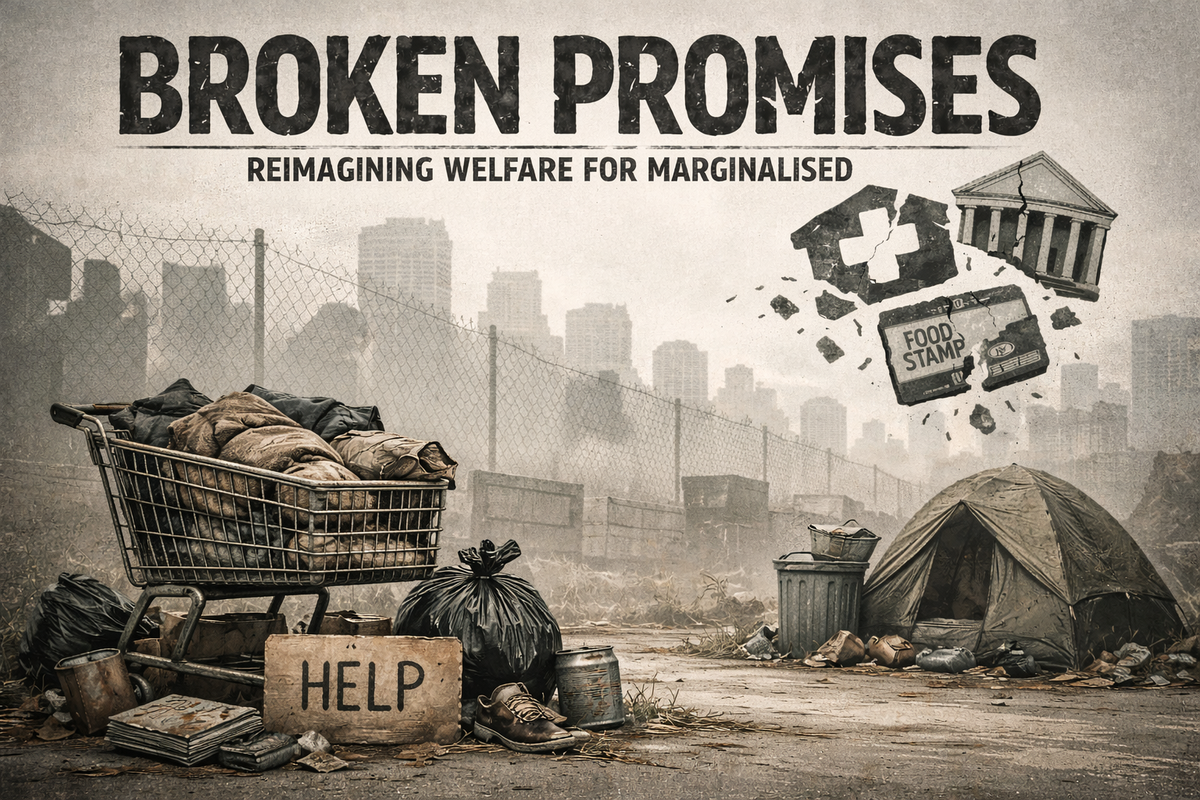
BROKEN PROMISES – REIMAGINING WELFARE FOR MARGINALISED
Introduction
India being a democratic country, has the welfare of people of its country as a primary goal. The government, so have a duty to provide its citizen a quality of life that aligns with the contemporary issues by emphasizing the country’s responsibility towards its citizens. This involves ensuring access to education, healthcare, social security and other basic necessities to everyone regardless of their caste or gender. These norms for ensuring people’s welfare is laid down in the Directive Principles State Policy of the Indian Constitution. iipa
Ramesh, a worker who cleans sewers without protective gears which is a very common sight in India, is refused to get treated by local hospitals as ‘his kind’ should use the government dispensary. His daughter couldn’t get scholarship, because the application required documents that he truly never possessed.
This man, Ramesh represents the millions of Indians, for whom welfare schemes exists in law but not in life. This article answers one central question – why do the existing welfare schemes fail and how should we reimagine welfare as the society evolves.
A look at Welfare schemes
India has a long record of social and human centric welfare initiatives that demand an equitable welfare allocation due to its history of discrimination towards the various classes such as Adivasis, Dalits and Unorganised sectors. These schemes address different type of vulnerability and poverty like-
Informal sector workers are given a specific pension plan called Pradhan Mantri Shram Yogi Maan-dhan (PM-SYM), it covers home-based workers, street vendors and landless workers. The life insurance is covered Pradhan Mantri Jeevan Jyoti Bima Yojana (PMJJBY) while Pradhan Mantri Suraksha Bima Yojana (PMSBY) is accident insurance. Atal Pension Yojana aims those who cannot pay income tax. ncdhr
One of the biggest welfare programmes in India is the Employment guarantee and a livelihood program. An annual of 100 day rural employment guarantee scheme is directed under MGNREGS and promised by every household. The National Rural Livelihoods Mission supports small-scale finances and community organisation, while the National Urban Livelihoods Mission (NULM) serves urban informal workers. ncdhr
Food and nutrition security is addressed by PDS, which gives subsidies on food under the National Food Security Act 2013. Janani Suraksha Yojana supports institutional delivery to pregnant women with conditional cash transfers. ncdhr
Sectoral schemes offer specific benefits to certain groups, handloom weaver, fishermen, construction worker, and sanitation workers. ncdhr
Health and education systems include Ayushman Bharat – Pradhan Mantri Jan Arogya Yojana (PM-JAY), provides health insurance that covers for families earning up to Rs. 5lakh a year. They provide Pre-Matric and Post-Matric Scholarship Schemes for SC/ST students through education. cbgaindia
Why schemes fail? – The Problem Analysis
Budget Illusion- According to the budget analysis report unveiled by the NCDHR at Press Club India, the funds intended for the upliftment and welfare of SCs and STs, have been diverted to general schemes like road construction and subsidiaries. The Interim Budget for 2024-25, totalling Rs. 51,08,780 crores, out which roughly about Rs. 290,402 allocated for Adivasis and Dalits but only 3.1% for SCs and 2.9% for STs approx. has directly the communities which is a lot less than the guidelines for the government. This means that remaining percent benefits those with better access like upper castes and wealthier population. cbgaindia
Discrimination at delivery- Even though the scheme exists and it reaches the intended beneficiaries, caste discrimination operates during its point of delivery. A report by CBGA and NCDHR shows that MGNREGA workers like Dalits and Adivasis get fewer work days than the upper caste workers in the same village, and also face delayed wages due to discrimination by local officials who work for scheme implementation. cbgaindia
In the PDS, Dalit families are reported receiving inferior quality of grains or sometimes even denied ration cards. ncdhr
Digital Exclusion and Fragmentation- Workers in informal sector lack employment contracts, bank accounts, income proof and other necessary documents of authentication which is required for accessing the benefits.
The biometric verification often fails due to workers roughened or callused hands, creating an excluding barrier in this digitalisation of welfare schemes. ncdhr
A migrant worker moving from one place to another loses its entitlement to benefits since different ministries operate separate schemes with each different eligibility criteria leading to no unified database, and so the same worker must register separately for health, pension and ration, each requiring different documents.
Understand welfare
India’s welfare system reflects an age old philosophy, where welfare is viewed as an act of state’s generosity rather than a lawful entitlement. A system which works on charity model susceptible to unjustified changes, cutting budgets and unstable in terms of implementation. However a system based on rights which will require clear duties of the state and provide the people with legal and institutionalised mechanism to demand correct delivery of welfare. So as society evolves the meaning of welfare should also evolve, from just keeping people above the surface level to actually teaching them to swim to the shore.
How can this be achieved?
Allocation of welfare should be transparent and targeted, that is by redirecting a certain percentage of SC/STs budget to direct their benefits as cash transfers or skill training and not for general infrastructure and also track funds where the money intended but never reaches.
Involvement of Dalit and Adivasis in scheme planning and implementation process. Making the entitlements in such a way that an insurance or card from one place works seamlessly elsewhere in India, by overcoming administrative barriers.
Align the schemes with constitutional provision of equality that turns it citizens to self-reliant rather than dependent.
Conclusion
India has many welfare schemes but these often do not reach the people they are meant for. Funds are lost or misused, favour is shown at times, and a lack of computer knowledge, along with too many agencies, prevent Dalits, Adivasis, and informal workers from claiming their right entitlements. The story of Ramesh proves welfare is mostly just a law, not a benefit. To make welfare real it must change from aid to right. We should see the role of welfare agencies as accountable, it should use SC/ST cash for their funds, and weaker groups must have a say.
Cash benefits must be portable and the welfare system must follow the ideals of the Constitution. Only then can welfare do more than just support survival. It should really support dignity, fairness, and growth for all people.
References-
https://lddashboard.legislative.gov.in/sites/default/files/coi/COI_2024.pdf
http://www.ncdhr.org.in/wp-content/uploads/2024/07/Dalit-Adivasi-Budget-Analysi-2024-25.pdf
https://feminisminindia.com/2024/02/08/budgeting-for-inequality-examining-sc-and-st-allocations/#
https://www.iipa.org.in/GyanKOSH/posts/social-security-reality-reforms
https://www.cse.iitd.ernet.in/~aseth/caste-based-ictd2024.pdf
Keep Learning!
Join our WhatsApp group for more updates!
Visit Legalwiki.co for more legal updates.